By Dr. Jerath|JUL 10TH 2026
This guide is designed to give you a thorough, honest foundation for understanding laser skin treatments. If you’ve seen the term used loosely online and wondered what it actually means, how different laser treatments work, and whether they might be right for you, you’re in the right place. We’ll cover the science behind how lasers interact with skin, the types of treatments that fall under this category, the realistic benefits and limitations, and what a long-term approach to laser-based skin care actually looks like.
Before exploring the details below, it’s worth knowing that at Geneva Primary Care and Med Spa, we also offer anti-aging and skin rejuvenation services as part of a broader aesthetic care approach — including treatments designed to complement what laser technology can accomplish.
What Are Laser Skin Treatments?
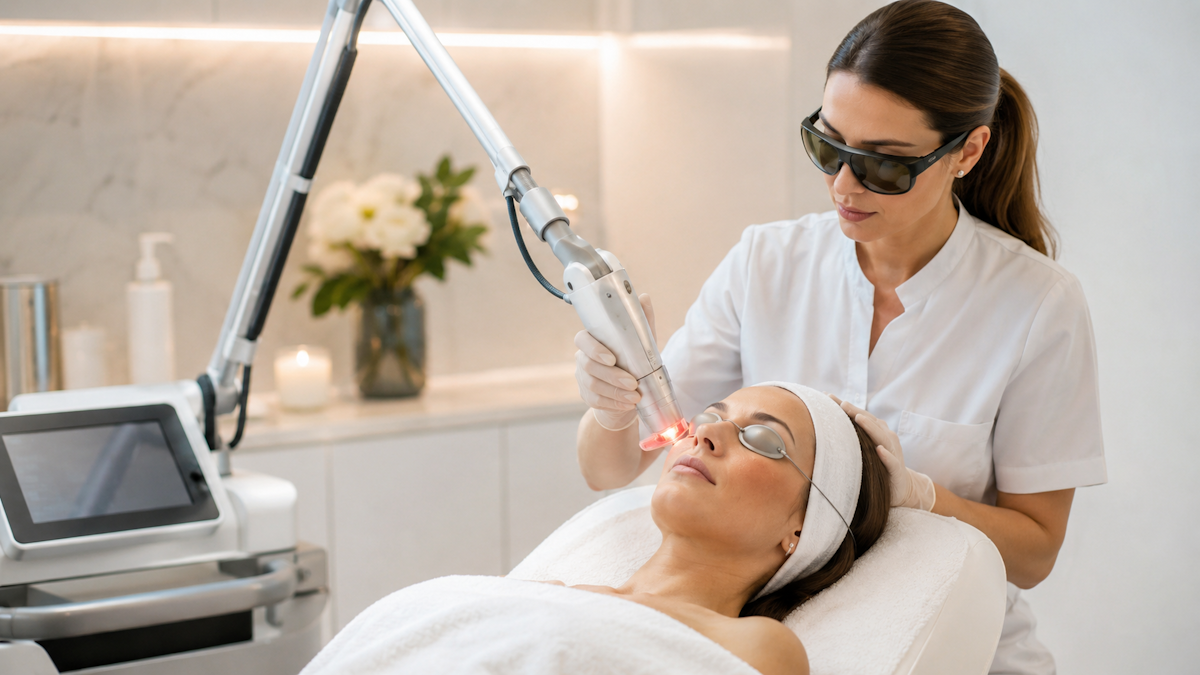
At their core, laser skin treatments use focused light energy to target specific concerns within or on the surface of the skin. The word “laser” is actually an acronym: Light Amplification by Stimulated Emission of Radiation. In practical terms, it refers to a device that emits a concentrated beam of light at a precisely controlled wavelength.
That wavelength is the key variable. Different colors of light are absorbed differently by different structures in the skin. A wavelength that targets melanin (the pigment responsible for dark spots and hair color) will largely bypass other tissue, concentrating its energy exactly where it’s needed. A wavelength designed to penetrate deeper skin layers will interact differently with water or collagen-producing cells. This specificity is what separates laser treatments from more generalized skin procedures.
When the targeted tissue absorbs the light energy, it converts to heat. That heat can destroy a hair follicle, break up pigmented cells, stimulate collagen production, or remove damaged surface layers, depending entirely on what the laser is calibrated to do. Understanding this helps clarify something important: “laser treatments” is a category, not a single procedure. There are dozens of different laser systems, each designed with specific applications in mind. A laser used for hair removal operates on entirely different principles than one used for skin resurfacing, even though both fall under the same broad label.
How Laser Technology Targets Skin Concerns
The variety of laser treatments available today is a direct result of decades of research into how different wavelengths interact with different tissues. Here’s how the primary mechanisms work.
Targeting Pigment
Melanin, the pigment that gives skin and hair their color, is highly effective at absorbing certain wavelengths of light. When a laser targets melanin, the absorbed energy causes those pigmented cells to heat up rapidly and break apart. The fragmented pigment is then cleared by the body’s natural processes over the following weeks.
This mechanism is the basis for treating sun damage, age spots, melasma, and other forms of hyperpigmentation. It’s also why these treatments need to be carefully calibrated for different skin tones — darker skin contains more melanin throughout the skin, not just in the targeted spots, which creates the need for specific laser types and settings to treat pigmentation safely across a range of complexions.
Targeting Hair Follicles
Laser hair removal works through the same melanin-absorption principle, but with a different goal. Instead of clearing surface pigment, the laser delivers energy deep enough to heat the hair follicle itself. When a follicle is damaged by that heat, its ability to produce new hair growth is disrupted.
Hair grows in cycles, and laser treatments are most effective during the active growth phase. This is why multiple sessions spaced several weeks apart are necessary to achieve significant hair reduction. Over a series of treatments, the majority of follicles in a treatment area can be permanently reduced, though individual results vary based on hair color, skin tone, and hormonal factors.
Stimulating Collagen Production
Not all laser treatments aim to destroy or remove tissue. Some work by delivering controlled thermal energy to the deeper layers of the skin without damaging the surface. This intentional heating triggers the skin’s natural wound-healing response, which includes an uptick in collagen production.
Collagen is the structural protein that keeps skin firm, smooth, and elastic. As we age, collagen production slows and existing collagen degrades, contributing to fine lines, looseness, and a change in skin texture. By stimulating new collagen growth, these laser treatments can improve skin quality from within over the weeks and months following each session.
Resurfacing the Skin
Laser resurfacing treatments remove or remodel the outermost layers of skin in a controlled, precise way. Ablative lasers vaporize the surface layer entirely, prompting the skin to regenerate with a smoother, more even appearance. Fractional lasers create thousands of microscopic treatment zones while leaving surrounding tissue intact, which speeds up recovery and allows for more targeted treatment of scars, deep wrinkles, or significant texture changes.
The end result of laser resurfacing, when done properly, is a visible improvement in skin tone, texture, and the appearance of scarring, including acne scars that have resisted other treatments.
Common Types of Laser Treatments
The range of laser treatments available today spans several distinct categories, each addressing different concerns.
- Laser hair removal. One of the most widely performed laser procedures, laser hair removal reduces unwanted hair on the face, body, and sensitive areas through targeted energy delivered to the hair follicle. Results build progressively over a series of sessions and can be long-lasting in the treated areas.
- Pigmentation correction treatments. These target melanin deposits responsible for sun spots, age spots, post-inflammatory hyperpigmentation, and uneven skin tone. The laser breaks up concentrated pigment, which the body then clears over time, revealing more even skin underneath.
- Wrinkle and fine line reduction. Laser treatments that work by stimulating collagen production fall into this category. They’re often non-ablative, meaning they work beneath the surface without removing the top layer of skin, making them well-suited for patients who want improvement without significant recovery time.
- Laser skin resurfacing. This category includes both ablative and fractional laser treatments. Ablative resurfacing removes surface layers and is typically reserved for more significant concerns like deep wrinkles or dense scarring. Fractional resurfacing treats a portion of the skin at a time and is often used for a broader range of texture, tone, and scar-related concerns.
It’s also worth understanding the distinction between ablative and non-ablative approaches. Ablative lasers physically remove the outer skin layer and typically produce more dramatic results with a longer recovery period. Non-ablative lasers stimulate beneath the surface without removing tissue, offering a more gradual improvement with minimal to no downtime. Neither approach is universally better — the right choice depends on your skin concerns, your skin type, and how much recovery time you can realistically accommodate.
Why Patients Choose Laser Treatments
The appeal of laser treatments goes beyond wanting to look better, though that’s a perfectly valid goal. For many patients, it’s about addressing skin concerns that have been a source of frustration for years and that haven’t responded meaningfully to topical products or less targeted treatments.
- Non-invasive or minimally invasive approach. Most laser treatments don’t require incisions, anesthesia, or surgical recovery. Patients can often return to normal activities relatively quickly, which makes laser treatments practical for people with full schedules.
- Precision targeting. Because laser energy is calibrated to interact with specific structures in the skin, the surrounding tissue is largely spared. This means treating a pigmented spot without affecting the skin around it, or addressing hair follicles without damaging the skin surface.
- Long-lasting results compared to topical treatments. Creams and serums work at the surface and need to be applied continuously to maintain any benefit. Laser treatments create structural changes in the skin — destroyed follicles, cleared pigment, new collagen — that persist far beyond the treatment period.
- Treating multiple concerns with one technology. Many patients have more than one skin concern. The same laser platform can often be used to address pigmentation, texture, and early signs of aging through different settings or applicators, reducing the need to layer multiple unrelated treatments.
It’s also worth noting that these benefits extend beyond appearance. Improving skin texture and tone can support overall skin health, and addressing pigmentation concerns early can help providers monitor changes over time. That’s part of why laser treatments have found a place not just in med spas, but in medically supervised aesthetic practices that take a broader view of skin health.
Why Laser Treatments Offer a Different Approach
If you’ve tried moisturizers, brightening serums, or over-the-counter exfoliants and found the results underwhelming, there’s a reason for that. Most traditional skincare products are designed to work at the surface. They can improve hydration, temporarily reduce the appearance of fine lines, or gradually fade mild discoloration — but they don’t change the underlying structure of the skin in any meaningful way.
Laser treatments operate on a fundamentally different premise. Rather than applying something to the skin and hoping it penetrates, laser energy is delivered directly to a targeted depth and tissue type. The comparison between these two approaches looks like this:
| Traditional Skincare Treatments |
Laser Treatments |
| Surface-level results |
Targets deeper skin layers |
| Short-term improvement |
Long-term skin remodeling |
| Product-dependent, ongoing cost |
Technology-driven, session-based |
| Requires daily consistency |
Progressive results over treatment series |
This isn’t an argument that topical skincare has no value — it does, and it plays a meaningful supporting role in maintaining laser results. But for patients whose concerns have reached a point where surface-level products aren’t moving the needle, laser treatments offer a genuinely different mechanism of action.
Who Laser Treatments Are Commonly Used For
Laser treatments aren’t limited to a narrow profile of patient. The range of concerns they address means that a wide variety of people find them relevant.
- Individuals with unwanted hair. Whether it’s facial hair, underarm hair, or larger body areas, patients who have found shaving, waxing, or other hair removal methods time-consuming and frustrating often turn to laser hair removal for a longer-term solution.
- Patients with sun damage or uneven pigmentation. Years of sun exposure leave their mark in the form of age spots, freckles that have deepened, and areas of uneven tone. Laser treatments that target melanin can significantly improve the appearance of sun-damaged skin.
- People noticing early signs of aging. Fine lines, a gradual loss of firmness, and changing skin texture are common concerns that appear in people’s 30s and 40s. Collagen-stimulating laser treatments can address these concerns before they become more pronounced, and maintaining results over time becomes part of a longer-term skincare strategy. Our blog on preventive health screenings by age touches on how proactive care at different life stages pays dividends — the same thinking applies to aesthetic health.
- Those with acne scars or uneven skin texture. Acne scars, particularly the depressed or pitted variety, are notoriously difficult to treat with topical products alone. Laser resurfacing treatments can remodel the skin’s surface and stimulate new tissue growth in a way that significantly reduces the visible appearance of scarring.
The common thread across these profiles is that the patient has a specific, identifiable concern that hasn’t responded adequately to other approaches. Laser treatments work best when the goal is clear and the treatment is selected accordingly — which is why evaluation before treatment matters so much.
Common Misconceptions About Laser Treatments
There’s a lot of loose information floating around about what laser treatments can and can’t do. Getting this right matters, both for setting realistic expectations and for making informed decisions.
- Not a one-time instant fix. Even highly effective laser treatments typically require a series of sessions to achieve meaningful results. Significant changes to pigmentation, hair growth, or skin texture take time to develop and become visible. Expecting dramatic results from a single appointment usually leads to disappointment.
- Not the same for every skin type. Laser technology has advanced considerably, but it isn’t one-size-fits-all. Certain wavelengths and laser systems are better suited to specific skin tones. Treatments that are safe and effective for lighter skin tones may carry risks for darker complexions if the wrong laser or settings are used. This is precisely why professional evaluation isn’t optional — it’s a safety requirement.
- Not all lasers treat all concerns. A laser system optimized for hair removal won’t perform like one calibrated for pigmentation correction. The category label “laser treatment” encompasses a wide variety of technologies, and assuming they’re interchangeable is a common misconception. The right system for your concern matters significantly.
- Not risk-free without proper evaluation. Laser treatments are generally very well-tolerated when performed correctly, but complications can and do occur when treatments are used inappropriately, on the wrong skin type, or by inadequately trained providers. A proper consultation and evaluation before any laser treatment is the most important step in ensuring a safe and effective outcome.
Why Laser Treatments Are Part of a Long-Term Strategy
One of the most useful shifts in perspective for patients new to laser treatments is moving away from thinking of any single session as “the treatment” and toward thinking of laser as a tool within a longer-term skin health strategy.
Collagen-stimulating treatments, for example, produce results that build gradually over weeks and months as new collagen forms and remodels. The full benefit of a series of sessions might not be visible until two to three months after the last appointment. Pigmentation treatments may require follow-up sessions if new sun damage accumulates. Hair removal requires a series of treatments timed to the hair growth cycle.
This doesn’t mean laser treatments are never-ending or that the investment doesn’t pay off — it means that the most successful patients approach them the way they’d approach any meaningful health goal. Consistency matters, maintenance supports results, and integrating laser treatments with a solid skincare routine amplifies the outcomes.
Effective skincare routines — including sun protection, quality topical products, and appropriate anti-aging skin care — are natural partners for laser-based treatments. Many patients also find that combining procedures, such as adding microneedling for collagen stimulation or chemical peels for surface renewal, creates a more comprehensive approach to skin health than any single modality can achieve alone. Dermal fillers and neurotoxins can address concerns that laser treatments aren’t designed to target, such as volume loss or dynamic expression lines, making them natural complements in a well-rounded aesthetic plan.
The takeaway is that laser treatments fit best within a coherent overall strategy, ideally guided by a provider who can look at your skin holistically and help you sequence treatments in a way that makes clinical sense.
Thinking Beyond a Single Treatment Session
When patients ask “how many sessions will I need?” the honest answer is that it varies — and understanding why helps set realistic expectations.
Most laser treatments require multiple sessions because of how the skin responds to treatment. Collagen production unfolds over time, not overnight. Hair grows in cycles that must be caught at the right phase. Pigmentation clears gradually as the body processes treated cells. These aren’t design flaws in the technology; they’re the natural biology of how skin heals, renews, and responds to stimulation.
Beyond the initial series, maintenance plays a role for many patients. This looks different depending on the treatment. Some patients find that annual or semi-annual sessions help sustain the improvements they’ve achieved. Others, particularly with hair removal, may need only occasional touch-up sessions after completing their initial series.
Results also vary based on several real-world factors:
- Skin type and tone. Certain skin types respond more readily to specific laser wavelengths, and the presence of significant melanin throughout the skin influences both the approach and the expected outcome.
- Condition severity. Mild sun damage responds more quickly to pigmentation correction than deep, long-standing hyperpigmentation. Shallow acne scars respond differently than deeply pitted ones. Starting point matters.
- Lifestyle factors. Sun exposure, skincare habits, and hormonal changes can all influence how long results last and how well the skin maintains its improvements between sessions. Patients who protect their skin consistently after treatment tend to see results that hold longer.
Understanding these variables ahead of time helps patients approach their treatment series with realistic expectations and a clearer sense of how to support their results between appointments.
Frequently Asked Questions About Laser Treatments
Are laser skin treatments safe for all skin types?
Laser skin treatments can be safe for a wide range of skin types when the correct laser technology and settings are carefully matched to the individual. However, not every laser system is suitable for every skin tone. Some wavelengths carry higher risk for patients with more melanin in the skin, which can lead to unintended pigmentation changes if the wrong system or settings are used. A thorough skin evaluation before any laser treatment is how a qualified provider identifies the right technology and parameters for your specific skin, making that consultation step essential rather than optional.
Do laser treatments hurt?
Most laser skin treatments cause mild to moderate discomfort rather than significant pain. The sensation is often described as a warm snapping or stinging feeling at the treatment site. The level of sensation varies based on the type of laser being used, the energy settings, and the area of the body being treated — more sensitive areas naturally feel more intense. Many laser systems include integrated cooling, and providers may apply numbing cream before treatments on sensitive areas to keep the experience manageable. Most patients find the discomfort very tolerable, particularly once they know what to expect.
How many laser treatment sessions are needed?
The number of sessions required depends on several factors: the specific concern being treated, the type of laser being used, and how your skin responds to treatment over time. Laser hair removal typically requires a series of six to eight or more sessions spaced several weeks apart to address hair in different growth phases. Pigmentation and skin resurfacing treatments may require fewer or more sessions depending on the severity and depth of the concern. Your provider will give you a realistic treatment plan during your consultation, but it’s worth understanding going in that laser treatments are generally a series, not a single appointment.
Are results from laser treatments permanent?
Some laser treatment results are long-lasting, particularly with laser hair removal, where treated follicles that are sufficiently damaged may not produce hair again. However, “permanent” is a word that should be used carefully. Hormonal changes, new sun damage, and the natural aging process can all influence how long results hold. Skin rejuvenation and resurfacing treatments stimulate improvements that can last for years, but the aging process continues, and some patients choose periodic maintenance sessions to preserve what they’ve achieved. The durability of results depends significantly on the type of treatment, your skin biology, and how well you protect and care for your skin afterward.
What is the difference between IPL and laser treatments?
The key difference lies in how light is delivered. Laser treatments use a single, highly focused wavelength of light, which allows for very precise targeting of a specific structure in the skin — a hair follicle, a pigmented lesion, or a layer of tissue. IPL (Intense Pulsed Light) delivers a broad spectrum of light across multiple wavelengths simultaneously, which can address several concerns at once but with less specificity than a true laser. Neither approach is inherently superior; the better option depends on the concern being treated, the patient’s skin type, and what the provider determines will achieve the best outcome. This distinction matters most when choosing the right treatment for a specific concern rather than selecting the one with the most familiar name.
What do laser skin treatments actually do?
Laser skin treatments use targeted light energy to create controlled changes in specific structures within the skin. Depending on the laser system and its settings, those changes might include destroying a hair follicle to reduce future hair growth, breaking up clusters of melanin to fade pigmentation, heating deeper skin layers to stimulate new collagen production, or removing damaged surface cells to improve texture and tone. The unifying principle is that light energy is converted to heat at a specific target, and that heat produces a clinically useful change. The wide variety of laser treatments available today reflects how many different skin concerns this single underlying principle can be applied to.
A Medically Informed Starting Point for Laser Skin Care?
Laser skin treatments represent one of the most significant advances in non-surgical aesthetic medicine over the past few decades. The ability to deliver precise, controlled energy to specific structures within the skin — without surgery, without significant downtime in many cases, and with results that build over time — has made laser technology a foundational part of modern skin care for patients with a wide range of concerns.
That said, the category is broad, the technology is varied, and not every laser treatment is appropriate for every patient or every concern. The most important step any patient can take is working with a provider who understands both the technology and the skin — someone who can look at your specific situation and recommend a treatment approach that makes clinical sense, not just a commercially available option.
At Geneva Primary Care and Med Spa, our approach to aesthetics is grounded in the same medical philosophy that guides our primary care practice: evaluate thoroughly, treat precisely, and support long-term results. Whether you’re exploring microneedling, chemical peels, Botox, or want to understand how laser treatments might complement your current skin care approach, we’re here to help you make sense of your options.
If you’d like to learn more about how we approach skin rejuvenation, take a look at our anti-aging and skin rejuvenation services page for a full overview of what’s available at our Alpharetta practice.
Geneva Primary Care and Med Spa
3275 North Point Parkway Suite 204
Alpharetta, GA 30005
Phone (470) 704-9687
Explore Our Skin Rejuvenation Services in Alpharetta