By Dr. Jerath|SEP 27TH 2026
Why Hyperpigmentation Is One of the Most Common Skin Concerns
If you have been searching for how to get rid of dark spots, whether laser can remove hyperpigmentation, or whether laser works for melasma, the short answer is this: laser treatment for hyperpigmentation can meaningfully fade many kinds of discoloration, but it is not a single treatment and it is not always the right first step. Pigment that sits near the surface behaves very differently from pigment that sits deeper, and hormone-driven pigmentation follows its own rules entirely.
Brown patches, freckling across the cheeks, and leftover marks from old breakouts are some of the most common reasons patients in Alpharetta and North Atlanta come in for a skin evaluation. Georgia sun exposure adds up quietly over decades of commutes, weekends outdoors, and time by the pool. The good news is that pigmentation is one of the most treatable cosmetic skin concerns when the cause is identified correctly. The caution is that the wrong device, the wrong setting, or the wrong candidate can leave skin looking worse than before. If you are not sure which category your discoloration falls into, the most useful starting point is a skin pigmentation evaluation with a clinician who can look at your skin in person.
What Is Hyperpigmentation
Hyperpigmentation is a general term for areas of skin that appear darker than the surrounding skin because of excess melanin. Melanin is the natural pigment your skin produces to protect itself, mainly from ultraviolet light. When melanin-producing cells are triggered by sun, inflammation, heat, or hormones, they can overproduce pigment or deposit it unevenly. The result is skin discoloration and uneven skin tone rather than a change in skin texture.
Not all pigmentation is the same, and the differences matter for treatment planning:
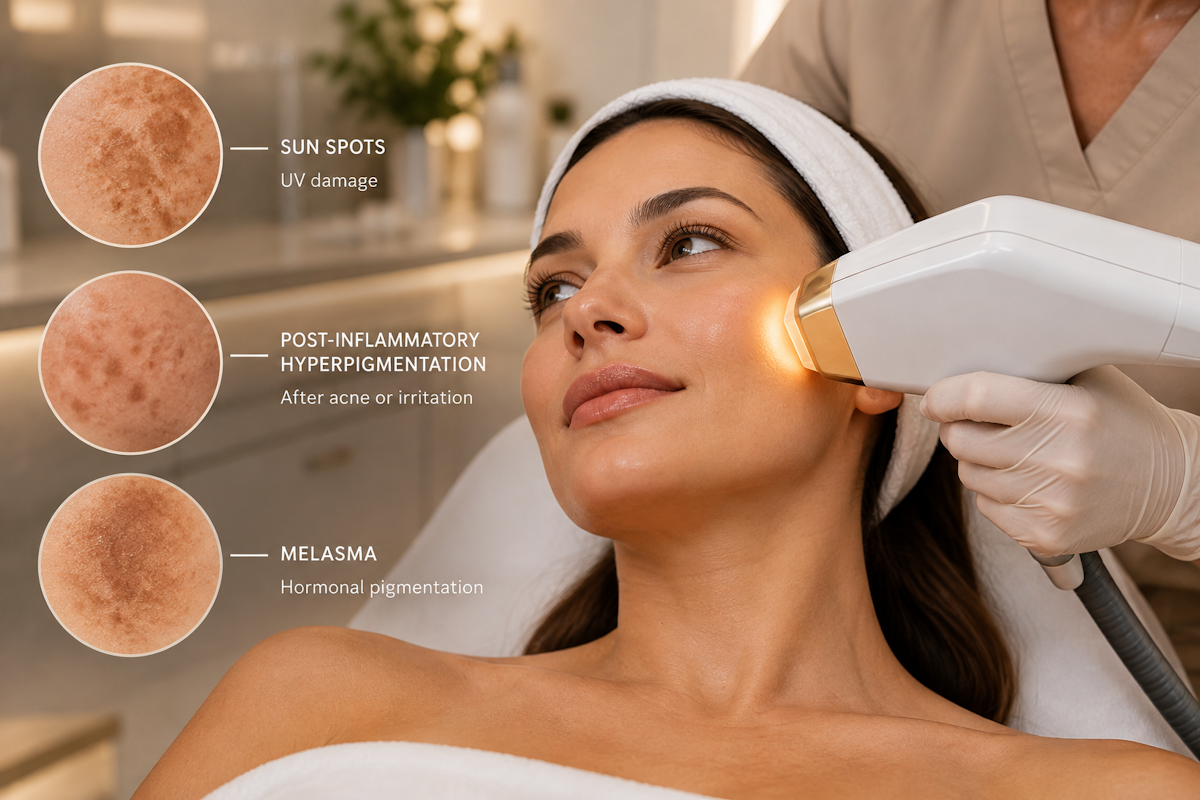
- Sun spots (also called age spots or solar lentigines): flat tan-to-brown spots on the face, chest, shoulders, forearms, and hands from cumulative ultraviolet exposure. These are usually well defined and sit relatively superficially.
- Post-inflammatory hyperpigmentation: the flat brown or gray marks left behind after acne, eczema, a bug bite, a burn, or a procedure. The original inflammation is gone, but the pigment response lingers. These marks often fade on their own, though that can take many months.
- Melasma: symmetric patches, often across the cheeks, forehead, upper lip, or jawline, strongly associated with hormones (pregnancy, oral contraceptives, hormone therapy) and worsened by sun and heat. Melasma tends to recur and behaves like a chronic condition rather than a one-time spot.
Sorting these out is the whole game. Melanin overproduction from sun damage responds well to light-based treatment. Melanin overproduction driven by hormones can be provoked by that same energy. This is why a reputable provider will not put a laser on your face before deciding what kind of pigment they are looking at.
How Laser Treatments Target Hyperpigmentation
1. Targeting melanin
Lasers work on a principle called selective photothermolysis, which is a technical way of saying that specific wavelengths of light are absorbed more by some targets than others. Melanin absorbs certain wavelengths strongly. When a pulse of that light hits a pigmented spot, the melanin takes up the energy and heats rapidly while the surrounding skin is left comparatively untouched. That sudden energy absorption fragments the pigment clusters into smaller particles.
2. Natural skin renewal
Lasers do not erase pigment on contact. After treatment, your immune system does the cleanup. Specialized cells carry the fragmented pigment away through the lymphatic system, while superficial pigment often rises to the surface, darkens into a fine coffee-ground speckling, and flakes off over roughly one to two weeks. This is why pigmentation results are gradual rather than instant, and why picking or scrubbing at treated spots is a bad idea. The general mechanics of light-based skin treatment are covered in more depth in our overview of how laser skin treatments work.
3. Precision matters
Different wavelengths penetrate to different depths and are absorbed differently by pigment, water, and blood vessels. A wavelength that is ideal for a crisp sun spot on the cheekbone may be poorly suited to a soft, deeper melasma patch. Pulse duration matters too, because a very short pulse shatters pigment mechanically while a longer pulse delivers more heat, and heat is exactly what can aggravate hormonal pigmentation. Device selection, wavelength, energy level, and spacing between sessions are all clinical decisions, not settings you should expect to be identical from patient to patient.
What Types of Pigmentation Can Laser Treat
Laser and light treatments are used for a fairly wide range of pigmentation concerns, including:
- Sun damage and age spots on the face, chest, arms, and hands
- Freckles and general sun-induced mottling in patients who want a more even tone
- Post-inflammatory pigmentation from acne, especially when it is paired with texture work such as acne scar treatment
- Overall dullness and uneven tone where pigment is one of several contributing factors
Some types simply respond better than others. Superficial, well-defined spots with crisp borders usually clear faster and more completely. Diffuse pigment with blurry edges, pigment that sits deeper in the skin, and pigment tied to ongoing hormonal or inflammatory triggers tend to improve partially and need maintenance. If active acne is still flaring, treating pigment before calming the inflammation often means new marks replace the old ones.
One honest caveat: not every brown spot is benign. Any spot that is changing in size, shape, or color, that has irregular borders or multiple colors, or that bleeds or will not heal needs a medical evaluation before any cosmetic treatment. Lasering a lesion that should have been biopsied is a real risk of skipping the exam.
Can Laser Treatments Treat Melasma
Laser treatment can improve melasma in some cases, but it must be used carefully, because melasma can worsen if it is treated too aggressively. That is the direct answer, and it deserves the emphasis.
Melasma is hormone-driven at its root. Estrogen and progesterone influence pigment cells, and those cells in melasma-prone skin appear to be unusually reactive to stimulation of almost any kind, including heat, friction, visible light, and ultraviolet exposure. A treatment that is strong enough to blast away a sun spot can, in melasma, trigger a rebound of pigment that arrives darker than the original patch. Because the underlying trigger has not changed, melasma also tends to return even after a good initial response.
For that reason, melasma is usually managed rather than removed, and laser is one supporting tool rather than the whole plan. A sensible approach often layers conservative, low-energy light settings with prescription or medical-grade topicals that reduce pigment production, gentle chemical exfoliation, strict daily broad-spectrum sunscreen with iron oxides for visible-light protection, physical shade, and attention to heat exposure. Where hormonal contributors are identified, they are worth discussing with your clinician. Our approach to pigmentation treatment starts with figuring out which of these components your skin actually needs. Results vary, and anyone promising permanent melasma clearance is overpromising.
IPL vs Laser for Hyperpigmentation
IPL for pigmentation
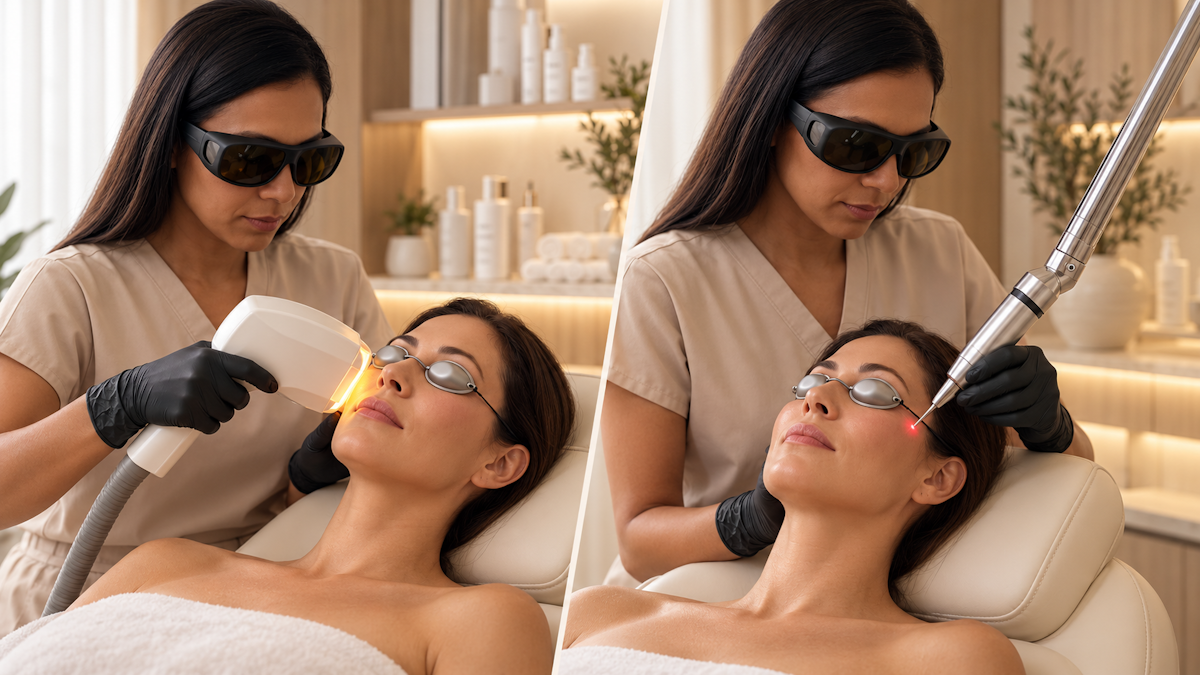
Intense pulsed light (IPL) is not technically a laser. It emits a broad spectrum of light filtered to target several concerns at once, including brown pigment and red vessels. That broad reach makes it useful for widespread, surface-level sun damage across the face, chest, or arms, and for patients whose main complaint is overall mottled tone rather than a few stubborn spots.
Laser for pigmentation
A laser emits a single, specific wavelength, which allows a more targeted interaction with pigment at a chosen depth. That precision makes lasers the better choice for deeper, denser, or treatment-resistant spots, and for situations where surrounding skin needs to be spared as much as possible.
Put plainly: laser treatments are generally more precise and better suited to deeper or stubborn pigmentation, while IPL is better for broader, milder discoloration across a larger area. There is also an important safety difference. IPL's broad spectrum carries more risk in richly pigmented skin, because background melanin competes for that energy. Deeper skin tones are often better served by specific laser wavelengths or by non-light approaches. If you want a side-by-side breakdown of the categories, our guide to IPL, laser, and resurfacing walks through the differences, and laser skin resurfacing is a separate option when texture, pores, and fine lines are part of the concern.
How Many Sessions Are Needed for Pigmentation Removal
Most patients need multiple sessions to see full improvement. A single treatment can visibly lighten isolated sun spots, but a genuinely even tone almost always takes a series spaced several weeks apart so the skin can complete its clearing cycle between visits.
What drives the number:
- Depth of pigment. Surface pigment clears faster than pigment that sits deeper in the skin.
- Type of discoloration. Discrete sun spots behave predictably. Melasma and post-inflammatory pigmentation are less linear and often need conservative, repeated passes.
- Skin type. Richer skin tones typically require gentler settings and therefore a longer, more gradual series to stay safe.
- Ongoing sun exposure. Without daily sun protection, new pigment forms while old pigment is being cleared.
A realistic plan is one your provider sets after seeing your skin, not a number quoted over the phone.
How Long Does It Take to See Results
Expect a sequence rather than a single moment. In the first few days, treated spots commonly look darker, not lighter. That temporary darkening is a normal sign the pigment has been affected and is migrating toward the surface. Over the following one to two weeks, those spots typically flake or fade, and the treated area starts to look clearer.
Meaningful, even improvement across a full face usually develops over the course of a treatment series, with the skin continuing to refine in the weeks after the final session. Maintenance matters as much as the treatments. Daily broad-spectrum sunscreen, reapplication when you are outdoors, and a supportive skincare routine determine how long your results hold.
Who Is a Good Candidate for Laser Pigmentation Treatment
Good candidates generally include people with visible sun damage or age spots, people with leftover acne marks whose breakouts are under control, and people who simply want a more even tone and are willing to commit to sun protection afterward.
Candidacy is less about age and more about the combination of skin type and pigment type. Your provider should ask about your tendency to burn or tan, any history of pigmentation problems after injury or procedures, current medications that increase light sensitivity, recent isotretinoin use, pregnancy or breastfeeding, a history of cold sores if treating around the mouth, active infection or inflammation in the treatment area, and recent tanning or self-tanner use. Any of these can shift the plan, delay treatment, or point toward a different option entirely. Not every patient is an ideal candidate, and hearing that from a provider is a good sign.
Are There Risks or Side Effects
Common, expected effects after pigmentation treatment include temporary redness, mild swelling, a warm sunburn-like sensation for a few hours, and the darkening and flaking of treated spots described above. Most people return to normal activity the same day, with makeup often possible within a day or two depending on the treatment.
The more significant risks are worth naming plainly: blistering or crusting if energy is too high, post-inflammatory hyperpigmentation (the treatment itself triggering new darkening), hypopigmentation or light patches where pigment is removed unevenly, prolonged redness, and, rarely, scarring. Melasma carries the added risk of rebound worsening. These risks rise with inappropriate device selection, overly aggressive settings, recent sun exposure, and treatment of skin types that were not properly assessed.
This is the same principle that applies to other light-based services such as laser hair removal and laser skin tightening: the safety margin comes from correct settings for your specific skin, not from the marketing name on the machine.
Is Laser Treatment Worth It for Hyperpigmentation
For many patients, yes. Laser treatment is worth it because it addresses pigment that already exists within the skin rather than only softening how it looks at the surface. Topical products such as retinoids, vitamin C, azelaic acid, and tyrosinase inhibitors are valuable, and they remain part of nearly every good pigmentation plan, but they work primarily by slowing new pigment production and speeding cell turnover. They are slower and less effective on deeper, entrenched deposits.
The practical trade-off looks like this: topicals are inexpensive, gradual, and require daily consistency. Laser is faster on defined spots, requires a series of visits and short recovery periods, and costs more up front. The two work best together, with the laser clearing what is there and the topicals plus sunscreen holding the result. Long-term improvement is realistic with proper aftercare. Permanence is not, especially when sun exposure or hormones remain in the picture.
Why Treatment Approach Matters More Than the Device
Patients often ask which laser is best. The more useful question is which plan is best for your pigment. Three decisions drive outcomes far more than hardware.
First, correct diagnosis. Sun damage, post-inflammatory pigmentation, and melasma can overlap on the same face, and they call for different intensities. Second, matching wavelength and settings to the concern and to your skin type, including a conservative test area when there is any question. Third, avoiding overtreatment. With pigmentation, restraint frequently produces a better final result than maximum energy, because the skin's inflammatory response is itself a pigment trigger. A provider who suggests starting gently and reassessing is applying clinical judgment, not underdelivering.
Why Patients Choose Geneva Med
Geneva Med is a physician-led practice in Alpharetta, and pigmentation is treated here as a medical skin concern rather than a menu item. That means a customized skin evaluation before any energy is delivered, medical-grade technology operated by trained clinicians, a plan that may combine in-office treatment with topicals and sun protection, and a deliberate preference for safe, gradual improvement over aggressive single sessions. If laser is not the right tool for your pigmentation, we will tell you that too.
To find out whether laser treatment for hyperpigmentation fits your skin, book a pigmentation consultation with Geneva Med. Call (470) 704-9687, visit us at 3275 North Point Pkwy Suite 204, Alpharetta, GA 30005, or schedule your visit online and bring your questions about dark spots, sun damage, or melasma.
Can laser treatments remove hyperpigmentation
Laser treatments can reduce hyperpigmentation by targeting melanin in the skin and breaking it into smaller particles. Over the following weeks, your body clears those particles naturally and superficial pigment flakes away, leaving a more even skin tone. How complete the clearing is depends on the type and depth of the pigment, and most people need a series of sessions rather than one.
Is laser treatment safe for dark spots
Laser treatment can be safe for dark spots when the correct wavelength and settings are used for your skin. Safety depends on skin type, how deep the pigment sits, recent sun exposure, medications that increase light sensitivity, and the experience of the person performing the treatment. Expected side effects include temporary redness, mild swelling, and short-term darkening of the spots before they fade.
Does laser treatment work for melasma
Laser treatment can improve melasma, but it has to be used cautiously because melasma can rebound and darken if treated too aggressively. Melasma is hormone-driven and heat-sensitive, so conservative settings are usually combined with pigment-reducing topicals, daily broad-spectrum sunscreen, and sun and heat avoidance. Melasma is generally managed over time rather than permanently removed.
How many sessions are needed to remove dark spots
Most patients need multiple sessions to significantly reduce dark spots, spaced several weeks apart so the skin can clear pigment between visits. The number depends on how deep and stubborn the pigmentation is, the type of discoloration, and your skin type, since richer skin tones are typically treated more gently over a longer series. Your provider can estimate a range only after examining your skin.
Is IPL or laser better for pigmentation
Laser treatments are generally better for deeper or stubborn pigmentation because a single wavelength allows more precise targeting, while IPL is better for mild, surface-level discoloration spread across larger areas like the face, chest, or arms. IPL also carries more risk in deeper skin tones because its broad spectrum of light is absorbed by background melanin. The right choice comes from an in-person skin assessment.
Can hyperpigmentation come back after laser treatment
Yes, hyperpigmentation can return, particularly when the original trigger is still present. Ongoing sun exposure, hormonal factors, and new inflammation from acne or irritation can all generate fresh pigment even after a successful treatment series. Daily broad-spectrum sunscreen, protective clothing and shade, and a maintenance skincare routine are what preserve results over the long run.
What should I avoid before and after laser pigmentation treatment
Avoid tanning, sunburn, and self-tanner for several weeks before treatment, since tanned skin raises the risk of burns and uneven results. Afterward, protect the area from sun, skip hot tubs, saunas, and intense workouts for a day or two if advised, and do not pick or scrub the darkened spots while they flake. Your clinician will give you specific instructions based on the device and settings used for your skin.