By Dr. Jerath|SEP 30TH 2026
It is also a well-studied approach rather than a novelty. The American Academy of Dermatology describes laser resurfacing as the most effective non-surgical option for tightening loose skin and reducing wrinkles and dark spots, while noting that the more intensive versions require roughly five to seven days of downtime and carry a greater risk of side effects, such as scarring, than gentler laser treatments. Strength and risk travel together, which is why device selection and provider judgment matter so much.
If you are weighing your options, a short skin assessment is the fastest way to get a real answer. Book a skin consultation with Geneva Med and we will tell you honestly whether a laser, an injectable, or both make sense for the lines that bother you.
What Causes Wrinkles and Fine Lines
Skin aging is not one process. It is several, and they overlap.
The structural driver is collagen loss. Collagen and elastin are the proteins that give skin its thickness and snap back. Production slows with age, and the existing framework gets damaged by ultraviolet light, which is why sun exposure ages skin faster than years alone. As that support layer thins, the surface loses its ability to bounce back from folding.
The second driver is movement. Every squint, smile, and frown folds the same piece of skin in the same direction thousands of times. Early on, those creases appear only during expression, which is what clinicians call a dynamic wrinkle. Over time, with less collagen underneath to reinflate the fold, the line stays visible at rest. That is a static wrinkle.
It helps to separate two categories when you are choosing a treatment:
- Fine lines: shallow, surface-level lines, often around the eyes and mouth, frequently paired with rough texture, dullness, and sun spots.
- Deeper wrinkles: folds tied to real structural change, including volume loss and repeated muscle pull.
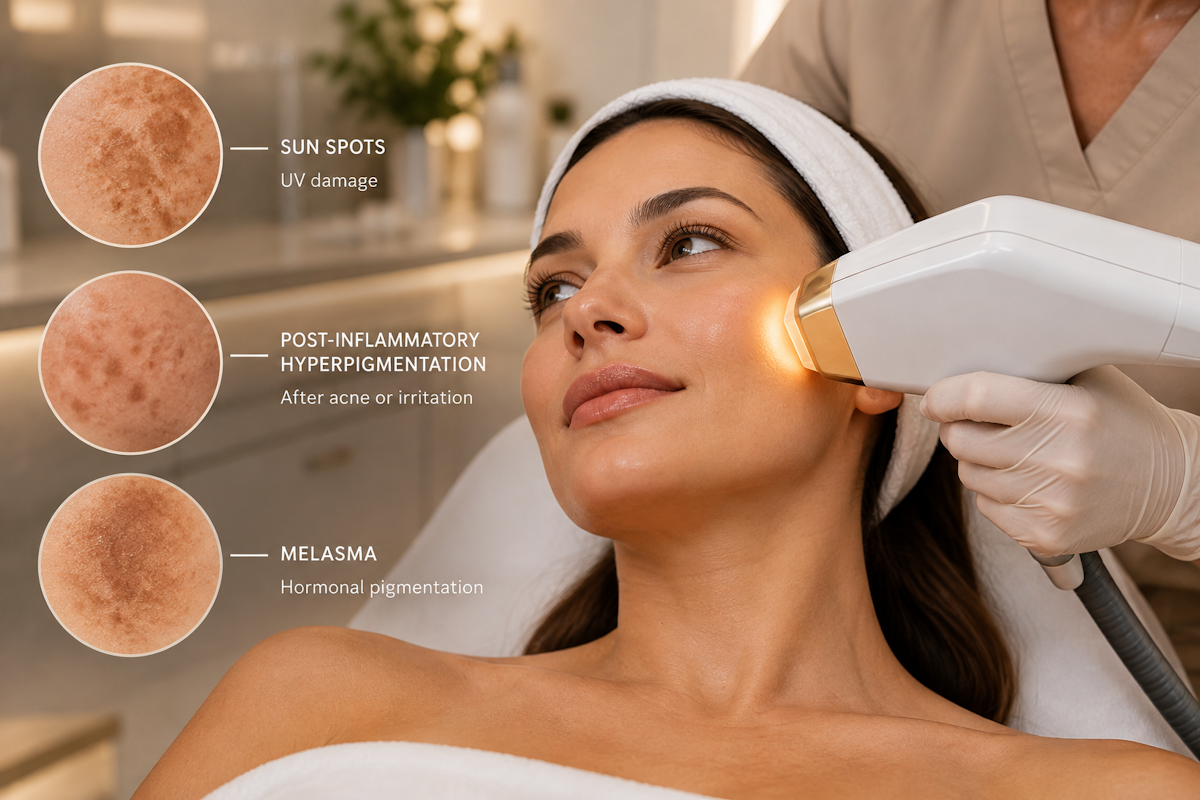
Pigment changes usually show up alongside texture changes, since both are driven largely by cumulative sun damage. That is why patients who come in for lines often end up discussing laser treatment for hyperpigmentation in the same visit.
How Laser Treatments Reduce Wrinkles
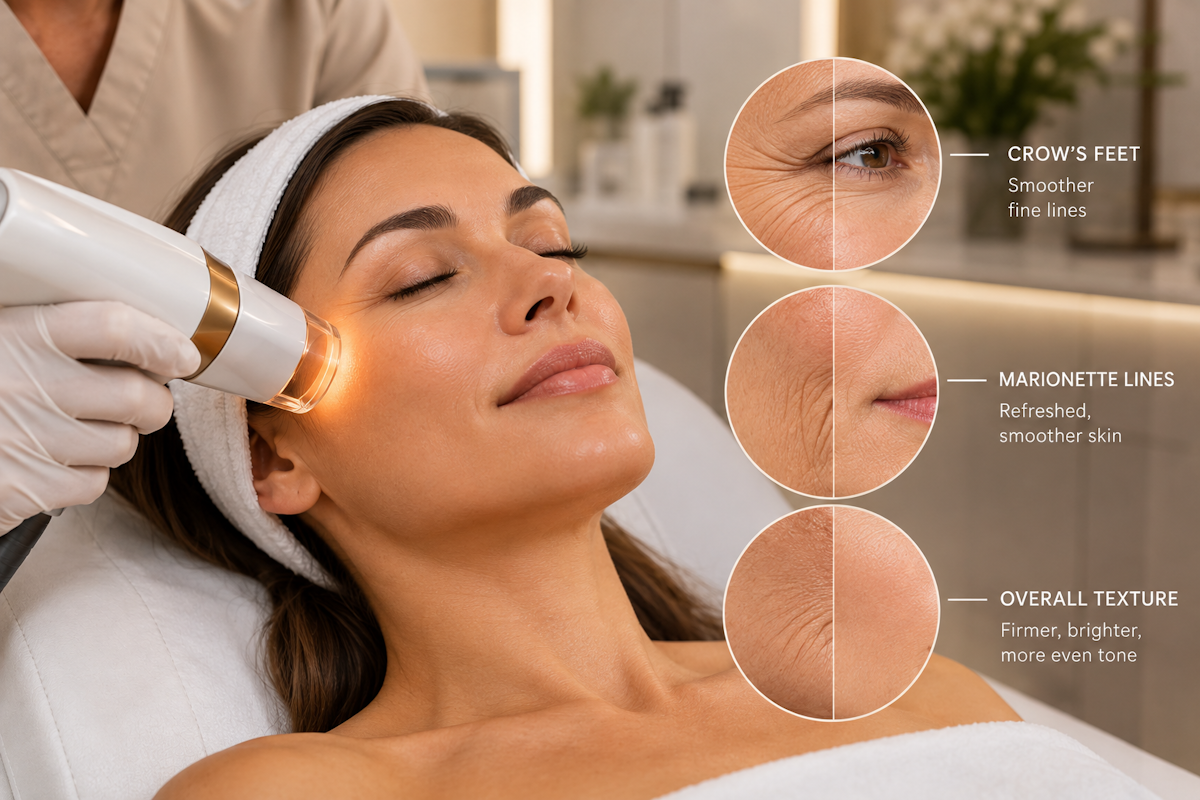
Lasers work by delivering a specific wavelength of light that is absorbed by targets in the skin, such as water or pigment. The absorbed light becomes heat, and that heat creates a controlled injury the body then repairs. Three things happen as a result.
1. Collagen Stimulation
Heat in the dermis, the deeper layer of skin, signals fibroblast cells to lay down new collagen. This is the slow part of the process and the reason results are described as gradual. The skin becomes progressively firmer and more resilient over the weeks and months after treatment as that new collagen matures. It is the same principle behind laser skin tightening.
2. Skin Remodeling
Collagen remodeling changes more than line depth. Patients typically notice that pores look smaller, texture feels smoother, and tone looks more even. Because fine lines are partly an optical effect, smoother skin reflects light more evenly and the lines read as less noticeable even before they measurably shallow out.
3. Surface Renewal
Some lasers also remove or disrupt the damaged outer layer of skin so it is replaced with fresh tissue. This is resurfacing, and it is where the more dramatic improvements in etched lines and sun damage come from. Our laser skin resurfacing page covers the process in more detail, and our overview of how laser skin treatments work explains what a session feels like start to finish.
Do Laser Treatments for Wrinkles Actually Work
Laser treatments can effectively reduce the appearance of wrinkles and fine lines by stimulating collagen and improving skin texture, though results vary based on wrinkle depth, laser type, skin condition, and how many sessions you complete.
The clinical evidence is reasonably specific. A randomized, double-blind, split-face trial published in Lasers in Medical Science compared fractional CO2 and fractional Er:YAG lasers and found statistically significant improvement in facial wrinkles with both devices, with no meaningful difference in results between them, though the CO2 laser caused more discomfort. In a separate prospective study of 30 patients treated with a single session of ultra-pulsed fractional CO2 laser for lines around the eyes, 93 percent of subjects reported satisfaction with the outcome, and three-dimensional skin analysis showed reduced wrinkle depth and improved wrinkle grading scores.
Where lasers do best:
- Fine lines and crepey texture
- Early signs of aging, before lines are deeply etched
- Sun damage, uneven tone, and rough surface texture
- Overall skin quality across a whole area rather than one line
Where lasers fall short on their own: deep dynamic wrinkles driven mainly by muscle pull, such as strong frown lines between the brows. You can improve the skin over that muscle, but if the muscle keeps folding it hard every day, the line will keep reappearing. Volume loss is similar. A laser does not replace lost structure.
Laser vs Botox: What Is the Difference
Laser Treatments
Lasers treat the skin. They improve quality, stimulate collagen, refine texture, and address pigment. Results build gradually over a series of appointments and continue developing after the final session. The improvement is diffuse, covering the full treated area.
Botox and Other Neurotoxins
Botox and Dysport are neuromodulators. They temporarily reduce the nerve signal to specific muscles so those muscles contract less forcefully, which softens the dynamic wrinkles those muscles create. Onset is fast, typically within days, and the effect is targeted to the muscles treated. Our guides to Botox injections in Alpharetta and how long Botox lasts cover the timeline, and our Dysport vs Botox comparison explains how the two products differ.
Which Is Better for Wrinkles: Laser or Botox
Laser treatments and Botox are not direct replacements. Laser treatments improve skin texture and collagen, while Botox targets muscle movement. Many patients benefit from a combination of both.
A practical way to think about it: if you look in the mirror at rest and see dull, rough, sun-damaged skin with fine crinkling, that is a skin-quality problem and lasers address it. If you see a line that deepens sharply when you raise your brows or squint, that is a movement problem and a neuromodulator addresses it. If the skin has lost underlying support and looks hollow rather than creased, dermal fillers may be the better conversation. Most faces show more than one of these at once.
Types of Laser Treatments Used for Wrinkles
At a high level, wrinkle-focused lasers fall into two families.
| Type | How it works | General trade-off |
|---|
| Non-ablative | Heats the deeper skin to stimulate collagen while leaving the surface intact | Less downtime, more gradual change, usually more sessions |
| Ablative | Removes damaged surface layers so new skin forms | Stronger resurfacing effect, more recovery time and higher risk |
Many modern devices are fractional, meaning they treat the skin in microscopic columns and leave untreated skin between them to speed healing. Device regulation is also worth knowing about: the FDA has granted clearance to specific picosecond laser platforms for the treatment of wrinkles, so laser wrinkle reduction is a cleared indication rather than an off-label stretch. Which family suits you depends on your skin type, your tolerance for downtime, and how deep your lines are, which is a decision for a facial assessment rather than a web page.
How Many Sessions Are Needed for Wrinkle Reduction
Most patients need multiple laser treatment sessions to see noticeable wrinkle reduction, with gradual improvement over time. Mayo Clinic notes that fractional nonablative and fractional ablative procedures typically require two to four sessions spaced over weeks or months, and that nonablative results tend to improve skin texture and color more than they smooth wrinkles.
Your own number depends on the condition of your skin at baseline, how much sun damage has accumulated, the laser and settings chosen, and how much change you are hoping for. A patient treating faint lines around the eyes and a patient treating decades of sun exposure are not on the same schedule. We would rather map out a realistic plan at the start than promise a single-session transformation.
How Long Do Results Last
Laser results appear in stages. Surface improvements in tone and texture often show up first, within a few weeks. The collagen-driven firmness continues developing for months after the last session, so the skin can keep looking better well after treatment ends.
What lasers cannot do is stop aging. Collagen keeps declining, and sun exposure keeps causing damage, so most patients plan periodic maintenance sessions to hold their results. Daily broad-spectrum sunscreen and a consistent skincare routine do more to protect your investment than anything else, and unprotected sun exposure after treatment can undo the gains and trigger pigment changes.
Who Is a Good Candidate
Laser wrinkle treatment tends to suit patients who have early signs of aging, fine lines, or mild to moderate wrinkles, and those who prefer a non-injectable approach to anti-aging. Patients whose main complaints include rough texture, dullness, large-looking pores, or sun spots alongside lines often see the most satisfying overall change, because lasers improve all of those at once.
Laser treatment may not be the right first step if you have deep expression lines driven mainly by muscle activity, significant skin laxity that needs a different approach, an active skin infection or inflammatory flare in the treatment area, or if you are pregnant or nursing. Darker skin tones can be treated safely with appropriate devices and settings, but the risk of post-treatment pigment change is higher, so provider experience matters. Certain medications and recent isotretinoin use also affect timing. All of this is why we do a full facial assessment and history before recommending anything.
Risks and Side Effects
Expected effects after most laser wrinkle treatments include temporary redness, mild swelling, warmth or a sunburn-like feeling, and some flaking or peeling as the skin renews. Skin is usually more sensitive to sun and to active skincare ingredients for a period afterward.
Less common risks include prolonged redness, changes in pigmentation (either darker or lighter), infection, cold sore reactivation in patients prone to them, and scarring, which is rare but more likely with aggressive ablative settings. The honest takeaway is that laser treatment is a medical procedure. Choosing the right device, the right settings, and the right candidate is what keeps the risk profile low, and that is a clinical decision, not a menu selection. The same principle applies to injectables, which is why we also publish detailed information on Dysport side effects and safety.
Is Laser Treatment Worth It for Wrinkles
Laser treatments are worth it for many patients because they improve overall skin quality, not just individual wrinkles, which tends to read as more natural-looking anti-aging. Smoother texture, more even tone, and stronger collagen support change how light hits the face. That is often what people mean when they say someone looks rested rather than treated.
The value is also cumulative. Because you are building collagen rather than temporarily blocking muscle signals, the improvement supports your skin over the long term instead of fully wearing off on a fixed schedule. It asks more patience and some recovery time in exchange.
Why Strategy Matters More Than Any Single Treatment
The patients who get the best outcomes are rarely the ones who picked the strongest single treatment. They are the ones who matched each concern to the tool that actually addresses it: a laser for skin quality, a neuromodulator for movement lines, filler for lost structure, and sun protection to keep it all. Skin quality and muscle movement are separate problems, and treating one while ignoring the other leaves an obvious gap. Men and women often need different dosing and placement strategies too, which our guide to Botox for men in Alpharetta covers.
Sequencing matters as well. Combining treatments is common, but spacing them properly and adjusting for your skin type is what keeps results even and risk low.
Why Patients Choose Geneva Med
Geneva Med is a physician-led practice in Alpharetta, which shapes how we approach laser treatments for wrinkles. We use medical-grade laser technology, assess your skin and health history before recommending a device, and build a customized anti-aging plan rather than selling a package. Our bias is toward natural results: we would rather under-treat and reassess than push settings for a faster before-and-after photo. And because we also provide primary care and wellness services, we can factor in the rest of your health picture.
If you want a straight answer about whether laser wrinkle reduction, injectables, or a combination fits your fine lines, come in and let us look at your skin. Call Geneva Med at (470) 704-9687 or schedule a consultation at 3275 North Point Pkwy Suite 204, Alpharetta, GA 30005, and we will build a plan around your skin rather than a generic protocol.
Do laser treatments remove wrinkles
Laser treatments can reduce the appearance of wrinkles by stimulating collagen and improving skin texture, but they do not completely eliminate all wrinkles. Fine lines and early aging respond best. Deep lines caused mainly by repeated muscle movement, or by loss of underlying volume, usually need a different or additional approach, and results vary from person to person.
Is laser better than Botox for wrinkles
Laser treatments are not necessarily better than Botox, because the two do different jobs. Lasers improve skin quality and build collagen in the skin itself, while Botox temporarily relaxes the facial muscles that fold the skin into dynamic wrinkles. Many patients benefit from using both, and a consultation is the best way to decide which one addresses the lines that bother you most.
How effective are laser treatments for fine lines
Laser treatments are well suited to fine lines, particularly in the early stages of aging, because they smooth surface texture and stimulate new collagen over time. Clinical studies of fractional lasers have shown statistically significant improvement in facial wrinkles and reduced wrinkle depth on objective skin imaging. Individual results still depend on skin condition, laser type, and the number of sessions completed.
How many laser sessions are needed for wrinkles
Most patients require multiple sessions to see noticeable wrinkle reduction, commonly in the range of two to four fractional laser treatments spaced weeks to months apart according to Mayo Clinic. The exact number depends on your skin condition, the depth of your lines, the device used, and your goals. Your provider should give you an expected range before you begin rather than after.
Do laser wrinkle treatments hurt
Most laser treatments cause mild discomfort rather than significant pain, often described as warmth or a quick snapping sensation against the skin. Intensity depends on the device and the settings used, and more aggressive ablative lasers are less comfortable than gentler non-ablative ones. Topical numbing cream and cooling are commonly used to keep the session tolerable.
How much downtime should I plan after a laser wrinkle treatment
Downtime depends on how intensive the treatment is. Gentler non-ablative laser sessions usually involve a day or two of redness that can be covered with makeup once your provider clears it, while full laser resurfacing can require roughly five to seven days of recovery according to the American Academy of Dermatology. Plan sun avoidance and diligent sunscreen use afterward regardless of the device, since sun exposure on healing skin can cause pigment changes.
Can I get laser treatment and Botox at the same time
Many patients do combine laser treatments with Botox or Dysport, since one addresses skin quality and the other addresses muscle movement. Timing and sequencing should be planned by your provider, because the order and spacing of the two treatments affect comfort, healing, and how evenly results settle. Bring up all treatments you are considering at your consultation so the plan can be built as a whole.