By Dr. Jerath|OCT 9TH 2026
What Skin Laxity Actually Is
Skin laxity is the loss of firmness and elastic recoil in the skin itself. Starting in your thirties, collagen production slows, elastin fibers become less springy, and the dermis (the supportive layer under the surface) thins. Sun exposure, genetics, hormones, and weight changes all speed that along. On the face and neck it shows up as a jawline that looks less defined than it did a few years ago, subtle jowling at the corners of the mouth, fine crepey lines on the neck, and skin that looks looser when you tilt your chin down.
How Laser Skin Tightening Works Below the Surface
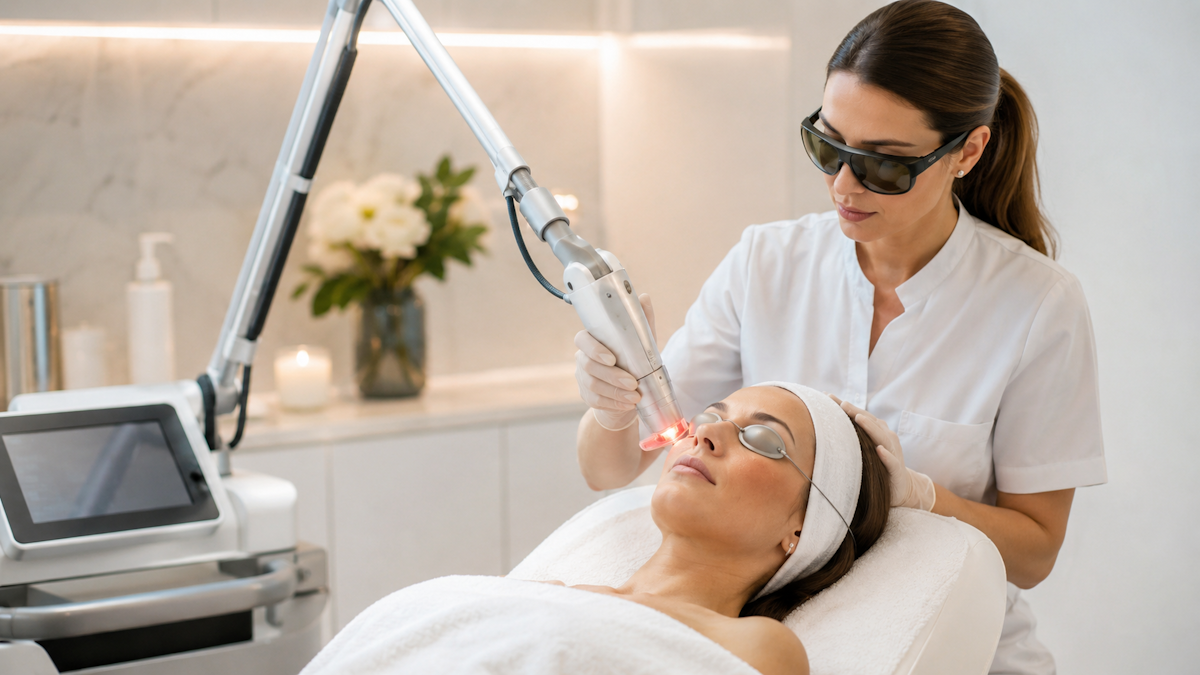
At GENEVA Med, the Sultra protocol runs on the HELIX platform by Cartessa and uses a fractional non-ablative 1570 nm wavelength. Non-ablative means the outer layer of skin stays intact: the laser passes energy through the surface and heats targeted columns in the dermis below. The American Society for Laser Medicine and Surgery describes the category plainly, noting that lasers and other energy devices tighten sagging skin by stimulating collagen without invasive surgery. If this is new to you, our overview of how laser skin treatments work is a useful companion read.
What Happens to Collagen After Treatment
Controlled heating in the dermis sets off a repair and remodeling response. Over the following weeks, existing collagen reorganizes, new collagen production (neocollagenesis) can occur, and dermal support gradually changes. The meaningful change is biological and unfolds over time, not a one-second contraction you watch happen in the chair.
Why Results Are Gradual
Unlike a filler, which creates an immediate structural change, collagen remodeling is slow by nature. GENEVA Med currently tells patients that Sultra results develop over roughly 6 to 12 weeks, usually across a treatment series. You will likely notice your skin feeling different before you can clearly see the difference in the mirror.
Where Laser Tightening Helps: Face, Jawline, Under the Chin, and Neck
Face and Lower Face
On the face, the realistic targets are overall loss of firmness, early lower-face laxity, mild crepiness, and the fine lines that come with thinning skin. Laser treatment improves the skin itself; it does not refill lost volume or move deeper structures, and the lines and wrinkles side of laser treatment is a somewhat different conversation.
Jawline and Early Jowling
This is where most people start. A jawline that is just beginning to soften, with mild laxity and subtle jowling, is a very different situation from pronounced jowls with substantial tissue descent. Early jawline softening is among the concerns Sultra is used for at GENEVA Med. Advanced jowls are not something a skin-remodeling laser can lift back into place.
Under the Chin
Loose skin under the chin is not the same thing as submental fat, and the two can look similar from the outside. You might have lax skin, fat, both, or anatomy that was always soft in that area. Laser tightening addresses the skin component only; it does not remove fat.
Neck
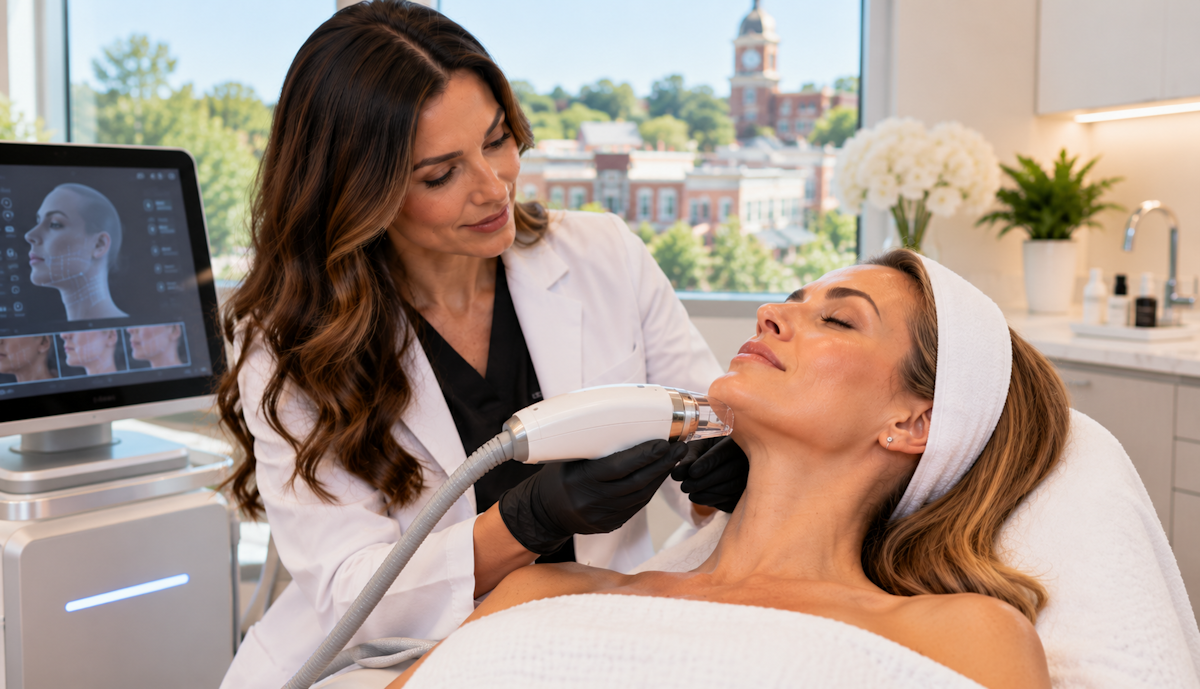
The neck follows the same principles: mild laxity, crepey texture, reduced firmness, and fine horizontal lines are reasonable targets. A 2024 study of a fractional 1570 nm laser reported improvement in face and neck laxity after three treatments, though it included only 16 women and the authors said larger studies are needed. That is supportive evidence for the mechanism, not a promise of a specific outcome for you.
What Kind of Loose Skin Responds Best to Laser Tightening
Laser skin tightening works best for early or mild-to-moderate laxity: subtle jawline softening, mild jowling, crepey neck skin, and a general loss of firmness. It is less appropriate when significant excess skin or deeper tissue descent is the main concern, because the laser stimulates the skin rather than removing or repositioning it. Whether moderate laxity is worth treating depends on your skin thickness, the area involved, how much loose skin is actually present, and what you hope to see. GENEVA Med states this plainly: laser tightening is not a replacement for a facelift, and significant sagging may call for a different approach.
Loose Skin, Facial Fat, and Volume Loss Are Different Problems
Two people can say "my jawline is sagging" and have completely different things going on.
- Skin laxity: the skin itself has lost firmness and recoil. This is the part laser tightening addresses.
- Fat: submental or facial fat can blur a contour, and a tightening laser is not a fat-removal treatment.
- Volume loss: as midface support fades, the lower face can look heavier by contrast. That is usually a conversation about dermal fillers or midface support.
- Tissue descent: deeper tissues shift downward over time, and a laser does not mechanically move them.
That is why the evaluation matters more than the device. Treating the skin when the real driver is fat or volume loss leads to disappointment, even when the laser performs exactly as designed.
Laser Skin Tightening vs CO2 Resurfacing: What Is the Difference
Tightening and resurfacing are different goals working at different depths. The non-ablative approach focuses on collagen remodeling under an intact surface. Fractional CO2 is ablative, meaning it removes microscopic columns of surface tissue, and it is the stronger choice for scars, etched lines, uneven texture, and sun damage. Our guide to the different types of laser treatments breaks that down further.
| Primary concern | Treatment approach | Main goal |
|---|
| Mild laxity, loss of firmness | Sultra, non-ablative | Collagen remodeling beneath the surface |
| Acne scars, deeper texture | Fractional CO2 | Resurfacing plus remodeling |
| Fine surface texture, less downtime | CoolPeel | Lighter fractional CO2 resurfacing |
| Laxity plus surface concerns | Fusion may be considered | Combined surface and deeper treatment |
When someone has both crepey laxity and surface damage such as sun spots and uneven tone, the HELIX platform can blend both technologies in a Fusion treatment. These are complementary, not interchangeable.
What Results Can You Realistically Expect
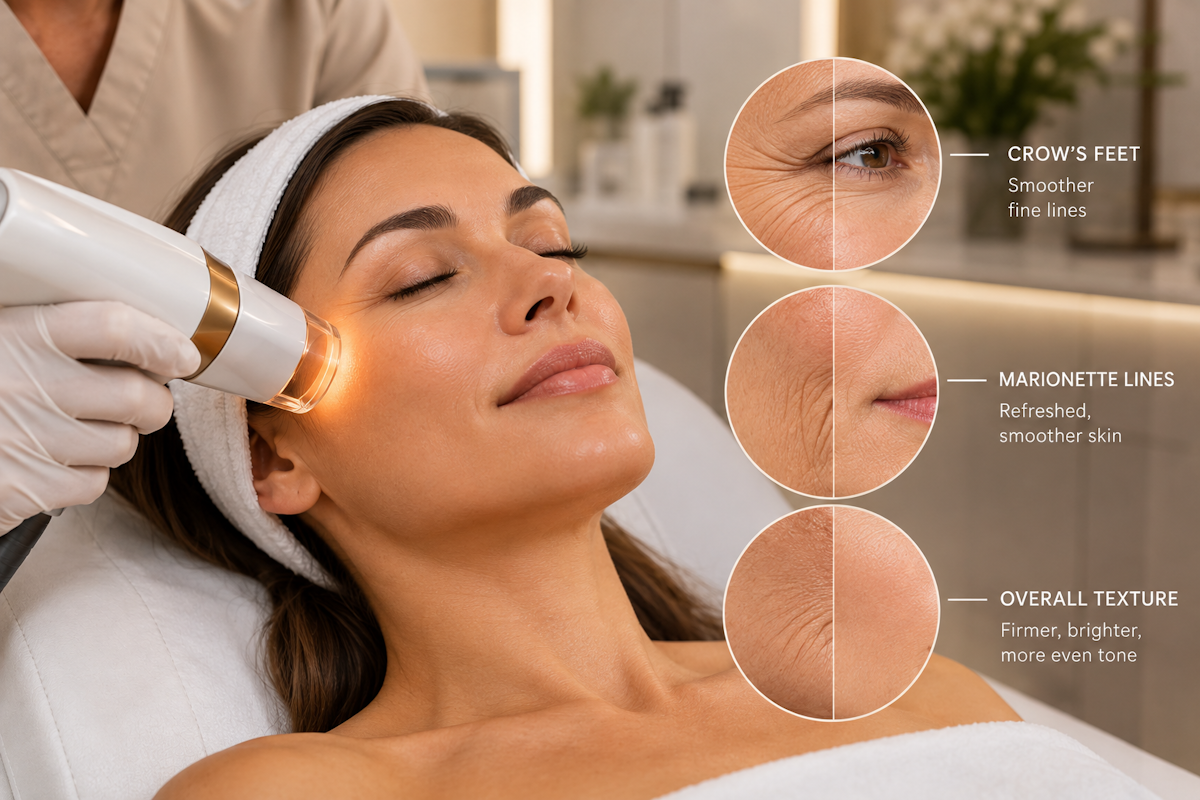
Think firmer, smoother, and better quality rather than lifted. Common improvements include skin that feels tighter to the touch, softened crepey texture, subtle refinement along the jawline, and fine lines that look less etched.
Timeline and Number of Treatments
GENEVA Med currently plans Sultra as a series of roughly three to four treatments, adjusted to the individual, with remodeling continuing between sessions. That is our current protocol, not a universal rule.
How Long Results Last
Collagen gains can persist, but your skin keeps aging. Sun exposure, genetics, skincare, and time all influence how long the improvement holds, and maintenance intervals vary from person to person. No one can promise permanence.
What Recovery Is Like After Non-Ablative Laser Tightening
Because the surface stays intact, visible recovery is generally limited. Most people see mild redness, warmth, and sometimes temporary swelling that settles over a day or so. That is not the same as "no downtime," and skin reacts differently from person to person.
During treatment, expect warmth and a prickling sensation, with occasional hotter spots; numbing or cooling is used where appropriate. It is also fair to know that energy-based skin tightening devices as a category are not risk free: the FDA has warned about serious adverse events reported with one plasma-based skin tightening device, including burns and skin color changes. Treatment belongs with a trained clinician who assesses your skin first.
Who Is a Good Candidate for Laser Skin Tightening
You may be a strong candidate if you have mild to moderate laxity, notice early jawline softening or crepey neck skin, prefer a non-surgical option, and can accept gradual improvement with limited visible recovery.
At your consultation, a provider should evaluate the degree of laxity, the treatment area, your skin type and tone, medical history, medications, previous treatments such as microneedling or resurfacing, and your goals. If what you really want is dramatic lifting of substantial loose skin, a different category of treatment is the more honest recommendation.
Find Out What Is Causing Your Skin Laxity
The most useful first step is not choosing a device, it is identifying whether your concern is skin laxity, texture, wrinkles, volume loss, fat, or a combination. GENEVA Med provides personalized laser skin tightening at its Alpharetta clinic for patients from Alpharetta, Johns Creek, Milton, and throughout Greater Atlanta, using Sultra on HELIX by Cartessa when it genuinely fits the problem.
To find out whether a laser for loose skin makes sense for your face, jawline, or neck, book a skin analysis with GENEVA Med. Call (470) 704-9687 or visit us at 3275 North Point Pkwy Suite 204, Alpharetta, GA 30005.
Frequently Asked Questions About Laser for Loose Skin
What is the best laser for loose skin?
There is no single best laser, because the right technology depends on whether your main concern is laxity, texture, scarring, pigment, wrinkles, or a mix. At GENEVA Med, Sultra's non-ablative wavelength is chosen specifically for collagen remodeling and mild to moderate laxity, while fractional CO2 is chosen when surface resurfacing is the priority. A skin assessment is what matches the tool to the concern.
Can laser tighten jowls?
Mild, early jowling driven by skin laxity may improve with laser tightening, since firmer skin along the lower face can soften the appearance. Pronounced jowls involving significant tissue descent are a different problem: the laser remodels skin, it does not reposition deeper structures. A provider should look at how much of your jowling is skin versus fat versus descent before recommending treatment.
Can laser tighten loose neck skin?
Yes, mild laxity and crepey neck texture are reasonable concerns for non-ablative laser treatment, and the neck is a commonly treated area. More advanced loose skin on the neck needs individualized assessment, because collagen remodeling alone may not deliver the change you are picturing. Neck skin is thinner than facial skin, so treatment settings and expectations are adjusted accordingly.
Can laser tighten skin under the chin?
Laser treatment can improve the skin component of mild under-chin laxity, but it does not remove submental fat. Since a fuller under-chin area can come from loose skin, fat, jaw anatomy, or a combination, the cause has to be identified before treatment is chosen. If fat is the main driver, a skin-remodeling laser is unlikely to change the contour meaningfully.
How long does laser skin tightening take to work?
Expect gradual change rather than an immediate result. Collagen remodeling continues for weeks after each session, and GENEVA Med currently describes Sultra improvement developing over roughly 6 to 12 weeks. Many people notice their skin feeling firmer or smoother before any visible difference shows up in photos, and the full picture is usually clearer after a completed series.
How many laser skin tightening treatments are needed?
GENEVA Med currently plans Sultra as a series of approximately three to four treatments, spaced out to allow remodeling between sessions. The final number is individualized based on your degree of laxity, treatment area, skin characteristics, and goals. More sessions do not automatically mean more tightening, and more heat in a single session does not either.
Can laser skin tightening replace a facelift?
No. Laser skin tightening can improve mild to moderate skin laxity and overall skin quality, but it does not remove excess skin or surgically reposition sagging tissue. If significant descent is your primary concern, a surgical consultation is the more appropriate path. Being clear about that difference upfront is how you avoid spending time and money on the wrong treatment category.